
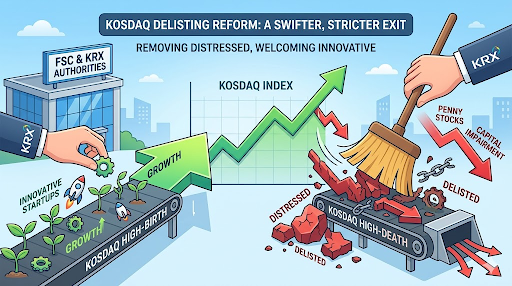
FSC and KRX Announce Delisting Reform Measures to Expedite Removal of Distressed Companies
On February 12, 2026, the Financial Services Commission (FSC) and the Korea Exchange (KRX) announced a comprehensive "Delisting Reform Plan" designed to facilitate the swift and strict removal of non-viable companies from the stock market. This initiative aims to transition the Korean capital market into a "high-birth, high-death" structure, ensuring that innovative firms can enter easily while distressed ones are promptly exited.
Background: Shift Toward a High-Efficiency Market
The government identified that the KOSDAQ market has historically operated under a "high-birth, low-death" model.
- Over the past 20 years, 1,353 companies were listed while only 415 were delisted.
- During this period, market capitalization grew 8.6 times, yet the market index only increased by 1.6 times.
- By comparison, the KOSPI index rose 3.8 times as its market capitalization grew 6.7 times.
- The continued presence of distressed companies has been cited as a factor that undermines market trust and potentially facilitates unfair trading practices.
1. Establishment of the Intensive Management Period
To ensure the effective execution of these reforms, an "Intensive Management Period" will run from February 2026 to June 2027.
- A dedicated "KOSDAQ Intensive Management Task Force," led by the KRX Vice Chairman, has been established with 20 personnel across four teams.
- For the 2026 KRX management evaluation, the weight of delisting-related performance will be significantly increased from 0% to a tentative 20% to incentivize proactive enforcement.
2. Strengthening the Four Major Delisting Criteria
The reform significantly tightens the requirements for remaining listed on both the KOSDAQ and KOSPI markets.
- Market Capitalization: The timeline for increasing market cap thresholds has been accelerated. For KOSDAQ, the requirement will rise to 20 billion KRW in July 2026 and 30 billion KRW in January 2027. Additionally, companies under "administrative issue" status will face immediate delisting if they fail to meet market cap requirements for 45 consecutive days within a 90-day window.
- Penny Stocks: A new delisting criterion for stocks priced below 1,000 KRW has been introduced. To prevent evasion through stock merges, companies will still be subject to delisting if their price remains below par value following a merge.
- Capital Impairment: In addition to the existing year-end audits, companies facing full capital impairment on a semi-annual basis will now be subject to a substantive delisting review.
- Disclosure Violations: The threshold for cumulative penalty points over a one-year period will be lowered from 15 to 10 points. Serious or intentional disclosure violations may trigger a delisting review after a single occurrence.
3. Procedural Efficiency and Legal Coordination
The reform also focuses on shortening the time distressed companies spend in the delisting process.
- The maximum "improvement period" granted to KOSDAQ companies during substantive reviews will be reduced from 1.5 years to 1 year.
- The government will coordinate with the courts to expedite provisional injunction lawsuits related to delisting, as lengthy litigation has previously delayed the final exit of failing firms.
Expected Impact and Timeline
According to KRX simulations, the number of KOSDAQ companies subject to delisting this year is expected to rise from an initial estimate of 50 to approximately 150 companies (ranging between 100 and 220).
- Immediate: The Intensive Management Period and task force are operational as of February 12, 2026.
- April 1, 2026: Implementation of procedural efficiencies, including shortened improvement periods.
- July 1, 2026: Enforcement of the four major strengthened delisting criteria.
The government plans to complement these exit reforms by further expanding technology-based listing tracks to ensure that the vacancies left by distressed firms are filled by promising innovative companies.

